
While it’s important to identify trends in how people of various demographics use technology and access the news, it’s equally important to acknowledge individual differences in a world that is rapidly shifting in terms of news access and mobile technology use.
The Reuters Institute’s 2016 and 2018 “Digital News Report” identified key trends in mobile and social media technology use.
The report identifies young people are heavy smartphone users with less TV and radio use but higher use of YouTube and podcasts. While older people tend to have higher TV and tablet use, the reports finds a decline in paid print media access among most age groups.
According to the report, when accessing digital news, women tend to use social media apps while men are more likely to visit individual news sites and use dedicated news apps.
My recent informal Twitter poll confirmed these trends. The poll (conducted from Feb. 2 to Feb. 8) asked users to identify how they get most of their news and stay informed.
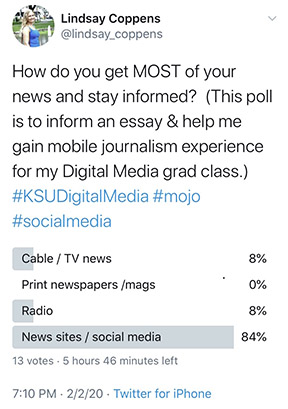
Eighty-four percent of the 13 respondents selected “news sites/social media,” with eight percent selecting “cable/TV news” and eight percent choosing “radio.” None chose the fourth option, “print newspapers/mags.”
However, even if most people do not use print as their primary news source, many do pay for some of their news.
According to my Instagram poll (conducted on Feb. 3 and 4), 83 percent of the six respondents said they pay for some of their news media.
High school teacher Deborah Saltzman, 58, is a print subscriber to The Boston Globe and the Sunday New York Times.
“I don’t read The Globe cover to cover, but I certainly read the front page each day,” Saltzman said.
Saltzman spends a good part of every Sunday morning picking through the Times, and she sets aside sections to read leisurely throughout the week.
Saltzman both fits and bucks the trends for her age and gender demographics.
She, unlike people across all demographics, identifies print newspapers as her primary news source, followed closely by radio and TV news.
Saltzman begins each morning listening to NPR as she gets ready for work and ends the day watching the local 10 o’clock news followed by “The Daily Show” with Trevor Noah.
“He puts his humorous spin on the news,” Saltzman said. “It’s surprisingly possible to keep up with the big issues through that lens.”
Facebook and direct email updates from The Globe and Times round out the news for Saltzman.
When accessing digital news, Saltzman says she occasionally clicks links in her Facebook feed and emails from the Globe and Times, but usually will read only the headlines.
Saltzman has a Twitter account but never uses it.
Conversely, and in line with the “Digital News Report” trends, high school senior Jonny Ratner, 17, gets almost all his news on his smartphone through Twitter and Instagram.
Ratner says he rarely clicks on links in these social media apps.
“Mostly I get news through headlines,” Ratner said.
To round out his news, Ratner uses the Apple News app and gets notifications from ESPN and Bleacher Report, occasionally visiting their sites directly on his phone or laptop.
Ratner estimates he uses his smartphone six hours each day, listening to music and watching YouTube after school and before bed.
Recent college graduate Anna Bebbington, 23, also uses her smartphone throughout the day to stay informed, but in a way different that’s from Ratner.
Like many young people in the “Digital News Report,” Bebbington, who prides herself on being well informed, depends on podcasts for news.
She begins each day downloading three podcasts: “The Daily” from The New York Times, NPR’s “Up First,” and the BBC’s “Global News.” Bebbington listens to these podcasts during her morning routine and while driving to work.
Bebbington also gets notifications from various news sites including The New York Times, The Washington Post and CNN.
Unlike Ratner, “I really don’t like the Apple News app but would rather just get notifications from the news organizations I choose,” Bebbington said.
Bebbington, who uses her smartphone and laptop throughout the day, says she “basically never” watches news on TV, which is in line with the “Digital News Report” findings for her age demographic.
Equally in line with his age demographic, Joe Raulinaitis, 70, identifies himself as “a big TV news guy.”
Raulinaitis, who watches CNN, Fox News and local news affiliates, says he likes TV news “for the visuals and how well they are done.”
“I try desperately to get a balanced picture of the country and the world,” Raulinaitis said while working at a café on his laptop.
Although his major news sources are cable and local TV news, Raulinaitis says, “When all else fails, you can go to the computer.”
When accessing digital news, like many of his gender demographic, he goes directly to cable news websites.
Reulinaitis says when seeking news online he uses his laptop to go to “organized news outlets with a responsibility to report accurately.”
He almost never uses his smartphone to access news sites, and while Reulinaitis has a Facebook account, he never uses it.
Whether through social media or podcasts, like most other young people, Ratner and Bebbington depend on smartphones to get their news while like other older news consumers Saltzman and Reulinaitis depend on TV news to keep up to date with what’s happening in the world.
However, each person is an individual that makes choices, which don’t always line up with what’s trending in the wider world.
 Lindsay Coppens: A Newspaper Adviser's Digital Explorations